
Improving Knowledge for Boosting Crop Yield in Africa
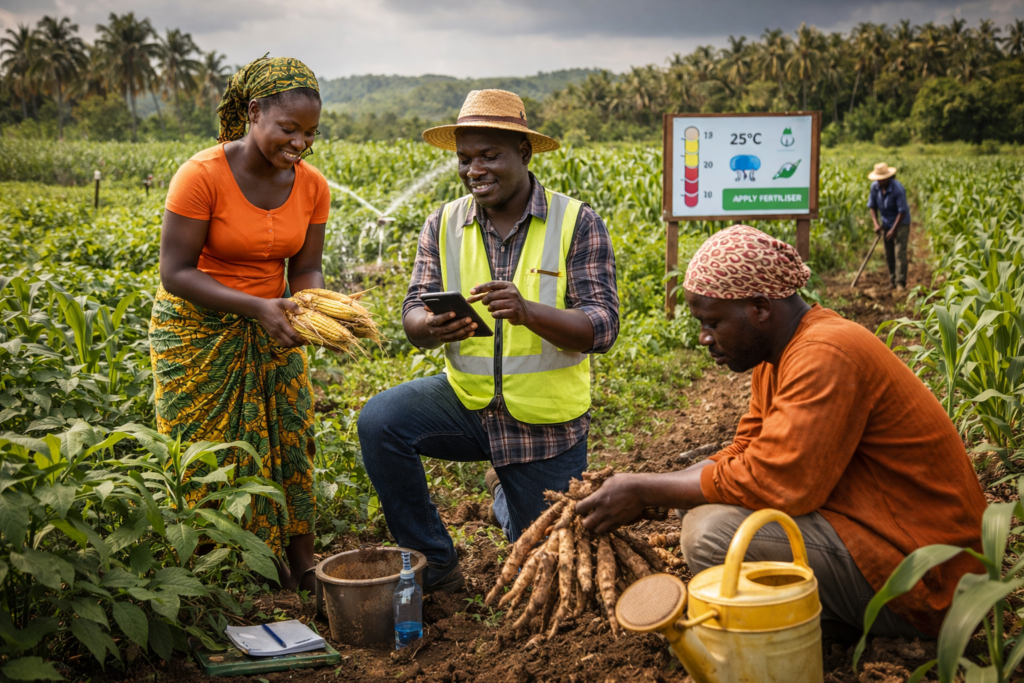
Across Africa, the challenge of low agricultural productivity continues to define the continent’s food security landscape. Despite vast arable land and a large population engaged in farming, crop yields remain significantly below global averages. Evidence shows that Africa still faces wide yield gaps—the difference between potential and actual farm output—with little convergence across regions, particularly in West Africa. For experts, the pathway to closing this gap lies not only in inputs or infrastructure, but fundamentally in improving knowledge systems that empower farmers with timely, relevant, and actionable information.
At the core of Africa’s agricultural challenge is a complex interplay of environmental, technological, and institutional constraints. Climate change has emerged as a dominant factor, altering rainfall patterns, increasing temperatures, and intensifying droughts and floods. These changes directly reduce crop yields and disrupt planting cycles across staple crops such as maize, sorghum, and millet. In Nigeria, for instance, prolonged droughts in the north and severe flooding events in recent years have devastated farmlands and reduced productivity, affecting both smallholder and commercial farmers. Similarly, in the Sahel and parts of East Africa, desertification now threatens nearly half of arable land, with projections indicating further yield declines of up to 15% by mid-century.
Beyond climate stressors, limited access to knowledge and advisory services remains a critical barrier. In many African countries, extension systems are weak, underfunded, and unable to reach the majority of farmers. In Kenya, for example, the ratio of extension officers to farmers is far below recommended levels, leaving farmers without adequate guidance on modern practices. This gap has forced many to rely on informal knowledge systems or outdated techniques, thereby limiting productivity. Across the continent, poor access to information on soil management, fertilizer use, pest control, and climate adaptation continues to widen the yield gap.
Pest infestations and crop diseases—exacerbated by climate change—cause yield losses of between 30% and 60% across several African farming systems.
Scientific studies further highlight that three primary drivers underpin low productivity in Sub-Saharan Africa: inadequate water management, insufficient fertilizer application, and poor agronomic practices. In Ethiopia, research shows that lack of access to improved technologies and market inefficiencies significantly constrain maize yields, despite high production potential. Similarly, pest infestations and crop diseases—exacerbated by climate change—cause yield losses of between 30% and 60% across several African farming systems. These challenges underscore the urgent need for knowledge-driven interventions that integrate science, technology, and local practices.
Encouragingly, emerging innovations across Africa demonstrate the transformative potential of knowledge systems. In Kenya, farmers are increasingly adopting digital advisory tools powered by artificial intelligence to diagnose crop diseases and optimize fertilizer use. These technologies provide real-time, location-specific recommendations, helping farmers improve yields despite limited access to extension officers. Similarly, seed banks across East and West Africa are promoting indigenous crop varieties that are more resilient to climate stress, pests, and diseases, thereby enhancing productivity and sustainability.
However, the adoption of such innovations remains uneven due to systemic barriers, including low digital literacy, weak infrastructure, and inadequate policy support. Studies indicate that while mobile-based advisory services and ICT platforms hold great promise, their impact is constrained by poor connectivity and limited capacity among farmers to utilize these tools effectively. This reinforces the argument that improving knowledge for agricultural productivity must go beyond technology deployment to include capacity building, institutional strengthening, and inclusive policy frameworks.
In Nigeria, where smallholder farmers produce the majority of food, improving knowledge systems is particularly critical. Many farmers still depend on traditional practices that are increasingly incompatible with changing climatic conditions. The absence of a coordinated, demand-driven agricultural advisory system further limits the dissemination of innovations developed by research institutions. As a result, improved seeds, climate-smart practices, and efficient water management techniques often fail to reach the farmers who need them most.
To address these challenges, experts advocate a shift toward cost-effective, knowledge-based techniques that can be widely adopted across diverse African contexts. Among the most practical approaches is rainwater harvesting, a low-cost method that enhances soil moisture retention and improves crop resilience in dryland regions. By combining indigenous practices with simple innovations such as contour bunding and soil mulching, farmers can significantly increase yields even under erratic rainfall conditions.
Another effective strategy is the adoption of improved seed varieties, including drought-tolerant and pest-resistant crops. Evidence shows that improved varieties can increase yields by up to 50% compared to traditional seeds in countries such as Nigeria and the Democratic Republic of Congo. When combined with proper soil fertility management—such as the use of organic manure and balanced fertilizer application—these seeds can unlock substantial productivity gains.
Integrated soil fertility management (ISFM) also offers a sustainable pathway to improving yields. This approach combines organic and inorganic inputs with improved agronomic practices to enhance soil health and nutrient availability. Similarly, crop diversification and agroforestry systems—which integrate trees with crops—help improve soil structure, reduce erosion, and increase resilience to climate shocks, particularly in regions affected by desertification.
Equally important is the strengthening of farmer-led knowledge exchange systems, including farmer field schools and community-based learning platforms. These approaches enable farmers to share experiences, test innovations, and adapt practices to local conditions. Evidence from multiple African countries shows that participatory learning significantly improves adoption rates of new technologies and enhances productivity outcomes.
Finally, the integration of digital advisory services—through mobile phones, radio, and community information hubs—can bridge the knowledge gap at scale. While high-tech solutions such as AI and satellite-based advisory systems are gaining traction, simpler tools such as SMS-based extension services and radio programs remain highly effective, particularly in rural areas with limited connectivity.
The evidence is clear: improving crop yields in Africa is not solely a matter of increasing inputs, but of transforming knowledge systems. By equipping farmers with the right information, tools, and support, Africa can unlock its vast agricultural potential and achieve sustainable food security. The challenge, however, lies in translating knowledge into action through coordinated efforts among governments, research institutions, private sector actors, and farmer organizations.
As Africa confronts the dual pressures of climate change and population growth, the need for knowledge-driven agricultural transformation has never been more urgent. For stakeholders across the continent, the message is unequivocal: investing in knowledge is not optional—it is the foundation for boosting crop yields, improving livelihoods, and securing the future of Africa’s food systems.
 Previous Post
 Next Post